THIS WEEK IN SAINT JOHN HISTORY
August 23–29
Saint John has centuries of stories behind its streets, harbour and river. Each day this week, we’ll look back at an event connected with Saint John and the history of New Brunswick.
📜 Sunday, August 23
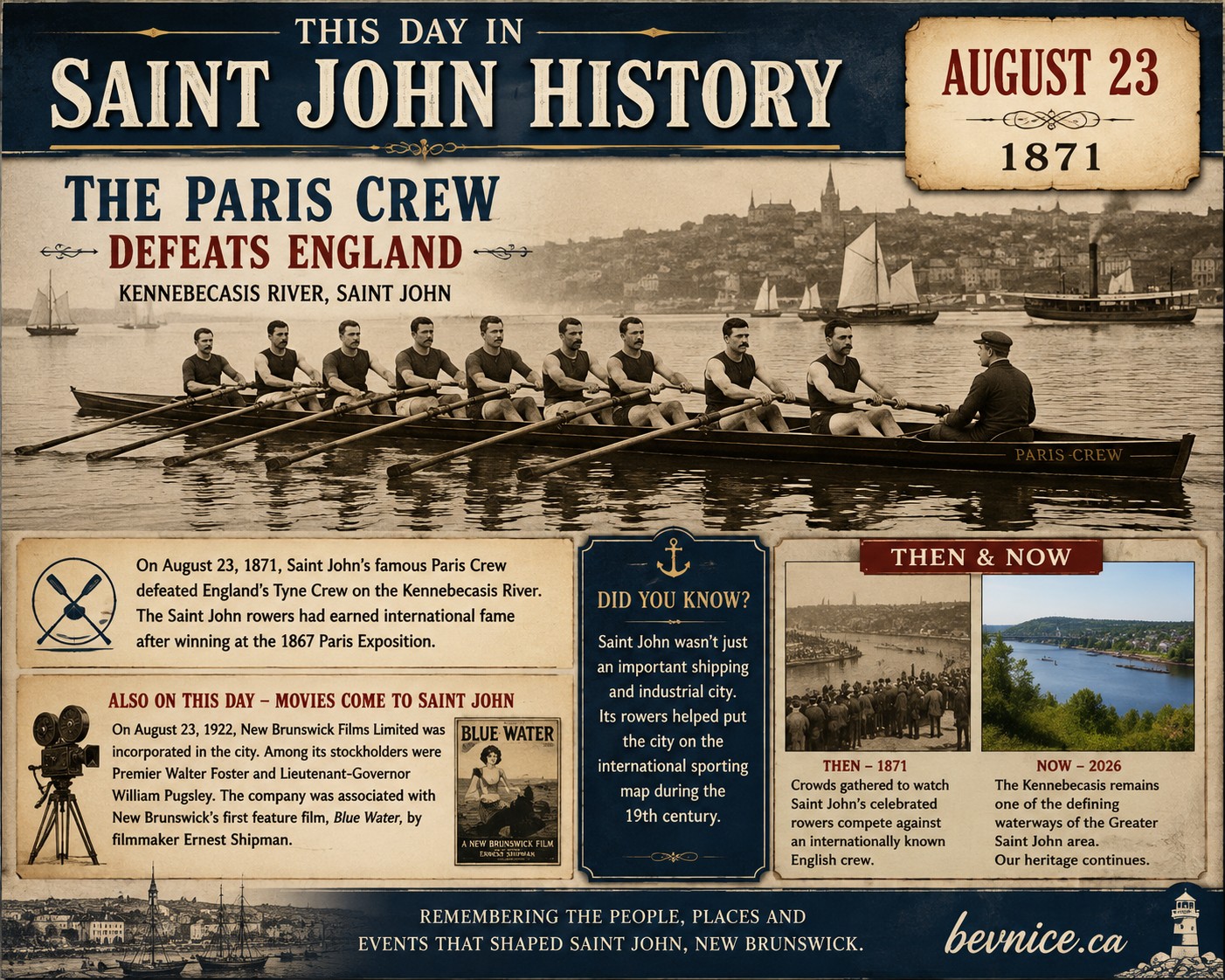
Saint John’s Paris Crew Defeats England
On this day in 1871, Saint John celebrated one of the great moments in Canadian rowing history.
The famous Paris Crew of Saint John raced England’s celebrated Tyne Crew on the Kennebecasis River and defeated them.
The Saint John crew had already become international sporting heroes after their victory at the 1867 Paris Exposition. Their August 23 victory brought another remarkable chapter to Saint John’s rowing history.
Did You Know?
The crew became known as the Paris Crew because of their famous 1867 victory in Paris.
Featured image idea: Four 19th-century rowers racing on the Kennebecasis River, with spectators lining the shore.
⚓ Monday, August 24
Saint John and the Age of Sail
The early 1800s were a remarkable period in Saint John’s development.
Its location at the mouth of the Saint John River helped turn the community into an important Atlantic port. Shipping, timber and international trade would eventually become defining parts of the city’s identity.
Featured image idea: Saint John Harbour during the Age of Sail, crowded with wooden sailing ships, warehouses and waterfront workers.
🌊 Tuesday, August 25
Conflict Comes to the Saint John River
On August 25, 1758, British military operations were being directed toward the Saint John River during the Seven Years’ War.
Colonel Robert Monckton was associated with the British campaigns of this period, when Acadian communities along the river were targeted.
It was a difficult and violent chapter in the region’s history, and its consequences affected Acadian and Indigenous communities as British control expanded.
Featured image idea: A respectful historical illustration of the Saint John River in 1758, showing settlements along the river rather than depicting battle.
🔥 Wednesday, August 26
Fire in Portland
On August 26, 1841, a major fire struck the Portland area of what is now Saint John.
The disaster began around the Owens and Duncan shipyard and destroyed the vessel Jane Duncan, homes and other buildings.
Fire was an enormous danger in 19th-century Saint John. Wooden buildings, shipyards, warehouses and closely packed neighbourhoods could allow flames to spread rapidly.
Featured image idea: Historical illustration of an 1840s Saint John waterfront fire, with residents and firefighters responding.
🏰 Thursday, August 27
The Struggle for the Saint John River
Long before the modern City of Saint John existed, control of the Saint John River was contested by European powers.
French and British interests competed for control of the river and surrounding territory, while the Wolastoqiyik had lived along the Wolastoq for thousands of years before European colonization.
Understanding this earlier history helps explain why the river became so important to the later development of Saint John.
Featured image idea: An old-map-style illustration of the Wolastoq/Saint John River showing early settlements and forts.
👶 Friday, August 28
An Early Birth at Fort Frederick
August 28, 1762 is associated with an interesting piece of early Saint John history.
Historical records concerning Fort Frederick, on the west side of the harbour, place the arrival of the Simonds-White-Peabody party on August 28, 1762. The settlement that followed became an important part of the development of the community at the mouth of the Saint John River.
The site of Fort Frederick is part of the story of Saint John before the Loyalist city was formally established.
Did You Know?
The modern City of Saint John would not be incorporated until 1785.
Featured image idea: Fort Frederick and the Saint John harbour shoreline as it might have appeared during the 1760s.
⚓ Saturday, August 29
Before Saint John Became a City
To finish the week, we go back to Saint John before incorporation.
The great Loyalist migration of the 1780s dramatically changed the settlement at the mouth of the river. Archival records include a Saint John Loyalist list from 1783–84, including 1,459 names in the Parr-town list and another 613 in the Carleton list.
Parr-town and Carleton would soon become part of something new.
In 1785, they were incorporated together as the City of Saint John.
That makes Saint John’s history visible on both sides of the harbour to this day.
Featured image idea: Parr-town and Carleton around 1783, with Loyalist ships entering Saint John Harbour.
🕰️ THEN & NOW
From Indigenous history along the Wolastoq to French and British rivalry, Loyalist settlement, wooden shipbuilding and international rowing victories, Saint John’s story stretches across centuries.
The harbour, river and neighbourhoods we know today still carry traces of that past.
Come back tomorrow for another “This Day in Saint John History.”
bevnice.ca