Mi’kmaw Communities Consider Indigenous-Owned Nuclear Power Project in New Brunswick
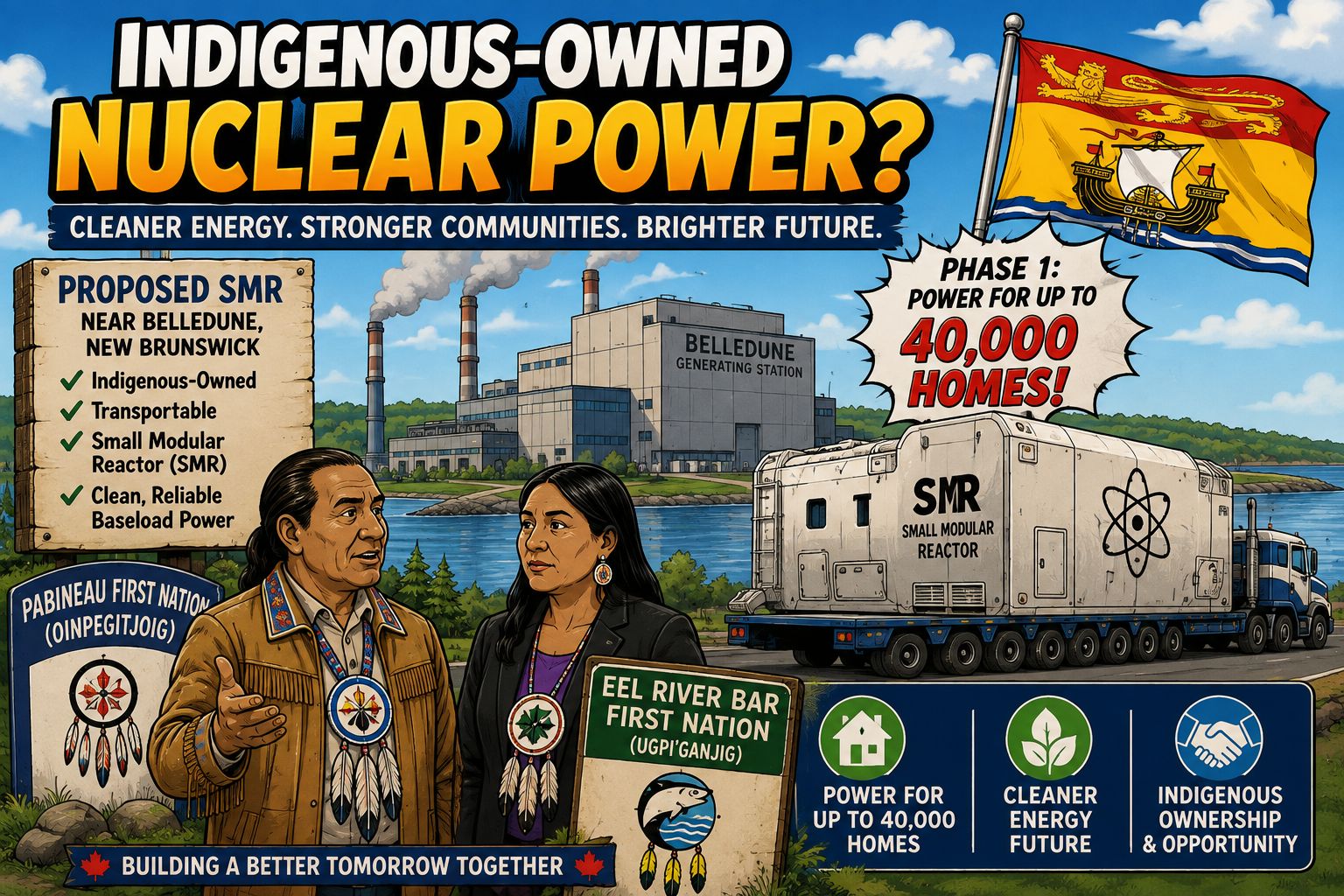
A proposed small modular reactor near Belledune could provide cleaner, reliable power for thousands of homes
Time is running out for one of Canada’s most polluting power plants, and two Mi’kmaw communities in northern New Brunswick are considering an innovative alternative.
Leaders in Pabineau First Nation (Oinpegitjoig) and Eel River Bar First Nation (Ugpi’ganjig) say they are considering a proposal to host a small modular reactor (SMR) near the existing Belledune generating station.
The proposal comes as the Belledune Generating Station faces a deadline to stop burning coal by 2030 as Canada moves toward cleaner electricity generation.
⚡ What is being proposed?
The concept would involve an Indigenous-owned transportable nuclear power station using small modular reactor technology.
Unlike traditional nuclear plants, SMRs are designed to be considerably smaller and potentially easier to deploy. They are intended to provide a steady supply of electricity, making them a possible source of baseload power alongside renewable energy such as wind and solar.
According to the proposal, the first phase of the project could generate enough electricity to supply up to 40,000 homes.
For northern New Brunswick, the project could represent a significant change in how electricity is produced and who owns the infrastructure generating it.
🪶 Indigenous ownership at the centre
One of the most significant aspects of the proposal is the potential for Mi’kmaw ownership and participation.
Pabineau and Eel River Bar leaders are considering whether their communities could play a direct ownership role in the project rather than simply hosting an energy facility.
That could create opportunities for Indigenous communities to participate in the economic benefits of the emerging clean-energy economy, including employment, training, investment and long-term revenue.
The proposal also reflects a broader trend across Canada in which Indigenous communities are seeking greater control over major energy and infrastructure projects located on or near their traditional territories.
🌱 Replacing coal
The proposed SMR would be located near the Belledune generating station, which has been an important source of electricity and employment in northern New Brunswick.
The existing plant has historically relied on coal, one of the more carbon-intensive fuels used for electricity generation.
With coal-fired generation scheduled to end by 2030, the region faces an important question:
What will replace that electricity while maintaining reliable power and protecting local jobs?
Supporters of nuclear technology argue that SMRs could help answer that question by providing dependable electricity with very low greenhouse-gas emissions during operation.
🏠 Power for up to 40,000 homes
The first phase of the proposed project could provide enough baseload electricity for as many as 40,000 homes.
That would make the project potentially important not only for the communities involved but for the wider northern New Brunswick electricity system.
Reliable baseload generation could also complement renewable sources, whose output can vary depending on weather conditions.
However, the project remains a proposal. Significant technical, regulatory, environmental and financial questions would have to be addressed before an SMR could be constructed and operated.
☢️ Nuclear power brings questions
While nuclear energy produces very little greenhouse-gas pollution during operation, nuclear projects also come with legitimate concerns.
Those include:
- Nuclear safety
- Radioactive waste management
- Emergency preparedness
- Environmental impacts
- Construction and operating costs
- Long-term decommissioning
- Regulatory approval
Any project near Belledune would therefore face extensive review before construction could begin.
Public consultation and meaningful Indigenous participation would also be important parts of the process.
💼 A potential economic opportunity
Northern New Brunswick has experienced significant economic change over the years, and the transition away from coal presents both challenges and opportunities.
An Indigenous-owned SMR project could potentially bring new investment to the region while creating skilled jobs in construction, engineering, operations and maintenance.
It could also position northern New Brunswick as a centre for emerging clean-energy technology.
For Pabineau and Eel River Bar, the opportunity is about more than replacing an aging power plant. It could be a chance to participate directly in the ownership of future energy infrastructure.
🔋 New Brunswick’s changing energy future
New Brunswick is already exploring several approaches to meeting future electricity demand, including nuclear energy, renewable power, energy efficiency and grid modernization.
The province is home to Point Lepreau Nuclear Generating Station, Canada’s only nuclear power plant outside Ontario, and has also been involved in the development of SMR technology.
The proposed Belledune project would add another potential piece to that energy picture.
🇨🇦 A project worth watching
The proposal from Pabineau and Eel River Bar is still at an early stage, but it raises an important question for New Brunswick and Canada:
Can cleaner energy development also create greater Indigenous ownership and economic participation?
If the project moves forward, the Belledune area could become an important test case for combining nuclear technology, Indigenous ownership and Canada’s transition away from coal.
For northern New Brunswick, the clock is already ticking toward 2030.
The next few years could determine what replaces coal at Belledune — and whether Indigenous communities have a leading role in the region’s energy future.
🍁 bevnice.ca
Atlantic Canada news, community stories and information.