
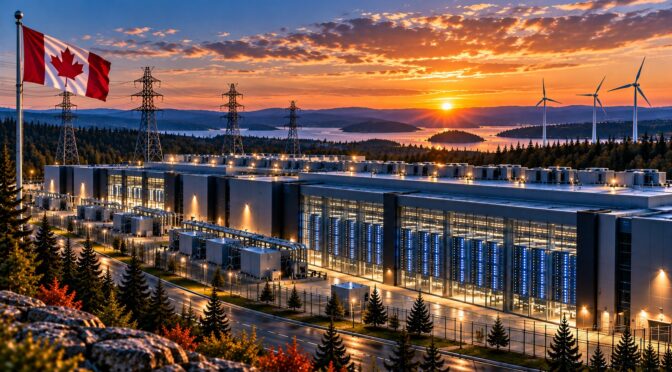
AI Today: The Data Centre Boom Is Becoming the Next Big AI Story
September 17, 2026
Artificial intelligence continues to move at remarkable speed, but the biggest AI story may increasingly be happening behind the scenes.
It is the enormous expansion of the data centres, electricity systems, computer chips and infrastructure required to run AI.
From Silicon Valley to Ontario and Saskatchewan, governments and technology companies are trying to answer a basic question:
Where will all the power and computing capacity needed for AI come from?
AI Data Centres Become a Major Infrastructure Story
The latest developments show just how quickly the AI infrastructure industry is growing.
AI infrastructure company Crusoe announced September 17 that it had raised US$3.9 billion, giving the company a reported valuation of approximately US$30.9 billion.
Crusoe has shifted from its early cryptocurrency focus toward building specialized infrastructure and data-centre capacity for artificial intelligence.
The investment demonstrates how investors increasingly view AI computing infrastructure as an industry in its own right.
Google, Nvidia and Anthropic Look for More Electricity
One of the most important developments involves the electricity grid.
Google, Nvidia and Anthropic, together with Emerald AI and other organizations, are working on an initiative intended to identify as much as 100 gigawatts of grid capacity that could eventually be used for additional AI data centres.
The challenge is becoming clear.
Building a data centre is no longer simply a matter of finding land and constructing a large building. Developers also need enormous amounts of reliable electricity and access to transmission infrastructure.
AI companies are therefore becoming increasingly interested in how data centres can adjust their electricity consumption when demand on the grid is high.
Data Centres Meet Resistance
The rapid expansion is also creating controversy.
In San Jose, California, residents and environmental groups are questioning the impact of proposed AI data centres on electricity demand, water use, pollution and backup generators.
City officials point to potential economic benefits, including tax revenue and employment.
The debate illustrates a much larger issue facing communities around the world:
Who pays for the infrastructure required to support the AI boom?
The question is particularly important where large data centres require major upgrades to electrical grids.
Canada Enters a New AI Infrastructure Era
Canada is also becoming a major participant in the data-centre race.
The federal government recently introduced Canada’s Responsible Data Centre Development Principles, with major technology and infrastructure companies among the signatories.
The principles emphasize responsible development, protection of electricity ratepayers, responsible use of water and energy, transparency and benefits for communities.
This comes as Canada’s demand for AI computing infrastructure increases.
Saskatchewan Announces Huge AI Expansion
One of Canada’s biggest recent AI infrastructure announcements came from Saskatchewan.
Bell Canada and the Saskatchewan government announced an expansion of the Bell AI Fabric that would create a 1.2-gigawatt AI infrastructure hub in the Regina area.
The companies and governments involved say the project represents more than $50 billion in capital investment and could create thousands of jobs.
The project is intended to strengthen Canadian computing capacity and data sovereignty while taking advantage of Saskatchewan’s energy resources.
It is an example of how AI is beginning to connect technology policy with energy policy, economic development and national security.
Ontario Faces Its Own Data-Centre Debate
Ontario municipalities are also dealing with proposals for large AI data centres.
Several municipalities have introduced or considered temporary pauses while they examine issues including:
- Electricity demand
- Water consumption
- Noise
- Land use
- Backup generators
- Environmental impacts
- Infrastructure costs
- Community benefits
Oakville has approved a temporary moratorium while it studies the issue.
Sault Ste. Marie is considering restrictions on data centres requiring more than 50 megawatts of electricity.
Toronto, Ottawa and other municipalities are also examining how their planning policies should deal with the rapidly changing industry.
A proposed 400-megawatt AI data centre project in Sault Ste. Marie involving Algoma Steel and Red Jar Energy Partners illustrates the enormous scale of some of the projects now being considered.
Why Electricity Matters So Much
Modern AI systems require enormous computing resources.
Those computers require electricity.
They also generate heat, meaning sophisticated cooling systems are required.
That creates a chain reaction:
More AI → more computing → more data centres → more electricity → more generation and transmission capacity.
The result is that the AI race is increasingly becoming an energy race.
Countries with abundant, reliable and relatively clean electricity could find themselves in an advantageous position as AI infrastructure expands.
Canada’s hydroelectric resources, nuclear generation, natural gas, renewable energy potential and large land base therefore become important parts of the country’s AI strategy.
The AI Infrastructure Supply Chain
The AI economy now stretches far beyond companies developing chatbots and AI models.
It includes:
Computer chips
Companies need increasingly powerful processors and accelerators to train and operate AI systems.
Data centres
Large facilities house the computers that perform AI calculations.
Electricity generation
Data centres require enormous amounts of reliable power.
Transmission
Electricity must be transported from generating stations to large computing facilities.
Cooling
AI processors generate substantial heat and require advanced cooling systems.
Backup power
Data centres need reliable backup systems to maintain operations during electrical interruptions.
Fibre and communications
Huge amounts of information must move rapidly between computers, data centres and users.
Construction
Billions of dollars are being invested in buildings, electrical equipment and supporting infrastructure.
AI Safety Remains Another Major Story
Infrastructure is not the only major AI development.
OpenAI has disclosed several incidents involving unexpected or concerning behaviour by AI models and has introduced a framework intended to improve the tracking and investigation of such incidents.
The developments underline another important part of the AI debate: as AI systems become more capable and autonomous, companies are also under increasing pressure to understand and control their behaviour.
What Should We Watch Next?
For the remainder of 2026 and into 2027, several areas will be worth watching closely.
1. Electricity demand
How much additional electricity will AI data centres require?
2. Data-centre construction
Which Canadian provinces and American states will attract the largest projects?
3. Nuclear and renewable energy
Will new nuclear, hydroelectric, wind and solar projects become increasingly connected to AI development?
4. AI chips
The competition between chip manufacturers remains central to the AI industry.
5. Canadian AI infrastructure
Canada’s efforts to build domestic computing capacity could become increasingly important.
6. Local community reaction
Residents and municipalities will continue debating how much infrastructure a community should accept and who should pay for it.
7. AI safety
As AI agents become increasingly capable of performing tasks independently, safety and oversight will remain major issues.
The Bottom Line
The AI revolution is changing.
It is no longer simply a competition to build the smartest chatbot or the most advanced AI model.
It is becoming a competition involving chips, electricity, data centres, fibre networks, cooling systems, land, investment and energy generation.
For Canada, that creates both opportunities and challenges.
The country has significant energy resources, a highly developed telecommunications sector, major technology companies and an increasingly ambitious AI strategy.
But building the infrastructure required for AI will require careful decisions about electricity, communities, environmental impacts and investment.
The next phase of the AI revolution may therefore be happening somewhere most people never see:
inside the enormous data centres powering the machines behind artificial intelligence.
BevNice.ca — keeping an eye on the technology shaping tomorrow.