Category Archives: Politics

Trump’s 51st State?

Trump’s 51st State? Trudeau Thinks So! 🇺🇸🇨🇦

Rumors are swirling that Donald Trump has his eyes on Canada—not just as a neighbor, but as the potential 51st state of the U.S.! And according to Justin Trudeau, it’s all a smokescreen.

Behind the scenes, some believe the real prize isn’t just Canada’s breathtaking landscapes, but its vast reserves of minerals, oil, and gas. With the global energy race heating up, control over Canada’s resources would be a massive win for the U.S. economy.

But here’s where it gets wild—Trudeau reportedly thinks this push is being disguised as a crackdown on drugs. Could there be a hidden agenda? Is Trump’s alleged interest in Canada about something much bigger than politics?

What do you think—conspiracy or cold, hard truth?

Trump has escalated tensions

In a series of recent actions, President Donald Trump has escalated tensions with several key international partners, including Canada, Mexico, China, the European Union, Denmark, and Panama. These moves have significant implications for global trade and diplomatic relations.

Tariffs on Canada and Mexico

President Trump announced plans to impose a 25% tariff on imports from Canada and Mexico, citing concerns over drug trafficking and illegal immigration. This decision has raised concerns about potential violations of the U.S.-Mexico-Canada Agreement (USMCA), which was designed to facilitate free trade among the three nations. Canadian Prime Minister Justin Trudeau has expressed a willingness to engage in constructive dialogue, while Mexican President Claudia Sheinbaum warned that retaliatory tariffs could jeopardize shared economic interests.


Increased Tariffs on China

The administration has also targeted China with an additional 10% tariff on Chinese goods, citing insufficient action to curb the flow of illicit drugs into the United States. China’s commerce ministry condemned these tariffs as “vile” and “unilateralist,” asserting that such measures escalate global trade tensions. The ministry emphasized China’s readiness to defend its rights against U.S. “bullying.”


Geopolitical Tensions with Denmark and Panama

Beyond trade, President Trump has reignited interest in acquiring Greenland, an autonomous Danish territory, and the Panama Canal. Danish Prime Minister Mette Frederiksen reiterated that “Greenland is not for sale,” affirming the island’s autonomy. In Panama, President José Raúl Mulino accused the U.S. of spreading “intolerable falsehoods” regarding the canal, following Trump’s assertion of intentions to “take back” the strategic waterway.


Potential Impact on the European Union

While specific actions against the European Union have not been detailed, the administration’s aggressive trade policies have raised concerns within the bloc. The EU is closely monitoring developments, particularly given the potential for tariffs or other measures that could disrupt transatlantic trade.

Global Implications

These developments have prompted discussions among global exporters about diversifying markets to mitigate the impact of U.S. tariffs. Countries are exploring alternative trade partnerships and strategies to reduce dependence on the U.S. market, acknowledging the economic leverage the U.S. holds.


As the situation evolves, the international community is bracing for potential shifts in trade dynamics and diplomatic relations resulting from the U.S.’s assertive policies.
 

The impact of retaliatory tariffs

The impact of retaliatory tariffs, like the 25% tariffs Canada might impose on U.S. goods, can be far-reaching, affecting various aspects of the economy on both sides of the border. Here’s a breakdown of the key effects:

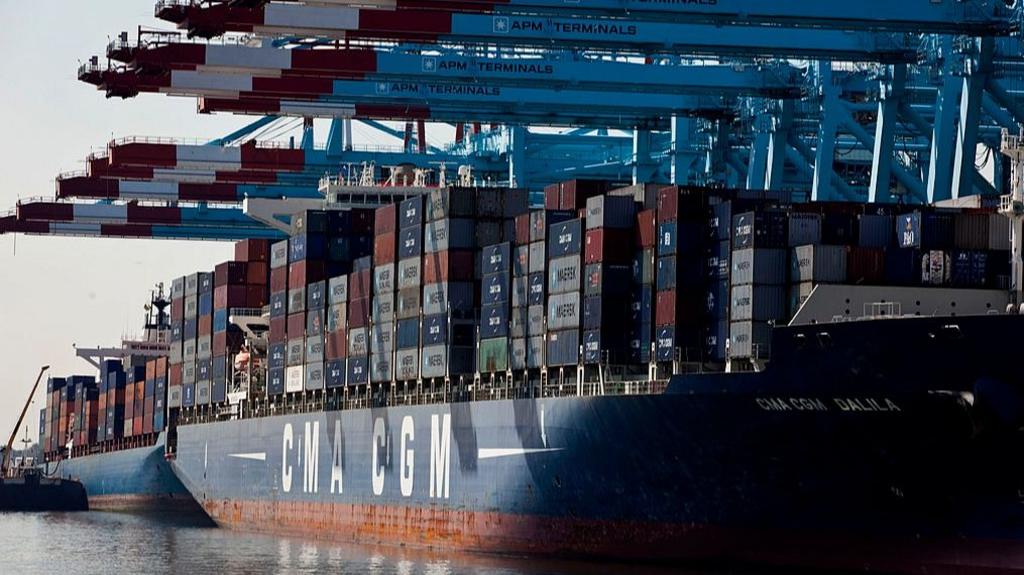
A shipping vessel is seen in New Jersey

1. Price Increases for Consumers:

  • Higher Costs: When tariffs are placed on imports, the price of those goods tends to rise. If Canada imposes tariffs on U.S. products, Canadians could see higher prices on items like American-made cars, agricultural products, and machinery. In turn, Americans could face higher costs for Canadian products like timber, steel, and aluminum.
  • Inflation: These price increases can contribute to inflation, especially if the tariffs target widely used goods or materials. The overall cost of living could go up, particularly for households dependent on goods that are imported.

2. Disruptions in Supply Chains:

  • Manufacturing Delays and Costs: Many industries depend on cross-border trade for parts and raw materials. For example, if Canadian companies rely on U.S. steel or agricultural goods, higher tariffs could disrupt their supply chains, forcing companies to find more expensive alternatives or pass on the costs to consumers.
  • Potential for Reduced Exports: In retaliating, Canada might target goods that are key U.S. exports, such as agricultural products or automotive parts. This could hurt U.S. producers who depend on the Canadian market.

3. Trade Diversion:

  • Shifting Trade Partners: Companies might seek alternatives to U.S. suppliers, shifting their focus to other countries that don’t have tariffs. For example, Canadian businesses could source goods from Europe or Asia instead of the U.S. This could lead to long-term changes in trade patterns and relationships.
  • New Trade Deals: On both sides, there may be a push to negotiate new trade deals or find new partners outside of the U.S.-Canada trade relationship, potentially opening up more competition or new opportunities.

4. Economic Growth and Job Losses:

  • Job Impact: Tariffs can hurt industries that rely on exports. U.S. manufacturers or Canadian farmers could lose business as a result of higher prices or reduced demand. In some cases, companies might move operations to other countries to avoid tariffs, potentially leading to job losses.
  • Reduced Economic Activity: The overall trade slowdown can affect broader economic growth. If consumers and businesses face higher costs or reduced access to certain goods, this could stifle economic expansion on both sides of the border.

5. Political and Diplomatic Strains:

  • Relations Between Countries: Trade wars often spill over into political tensions. Retaliatory tariffs might sour U.S.-Canada relations, making it harder to negotiate other areas of cooperation (such as defense, environmental issues, or immigration).
  • Global Market Impact: Canada and the U.S. are both major players in the global economy, so any disruption in trade could ripple through international markets. If other countries sense volatility, they might adjust their own trade strategies or impose their own tariffs.

6. Industry-Specific Impacts:

  • Automotive Industry: Since both Canada and the U.S. have integrated automotive supply chains, tariffs could make cars and car parts more expensive for consumers. Canadian auto manufacturers that export to the U.S. could see their products become less competitive in the U.S. market.
  • Agriculture: Farmers in both countries might bear the brunt of retaliatory tariffs. For instance, Canada could impose tariffs on U.S. dairy or meat products, which might hit U.S. farmers, while Canadian farmers who rely on U.S. exports could face similar disruptions.
  • Steel and Aluminum: Canada and the U.S. are both major producers of steel and aluminum. Tariffs in this area can hit industries like construction, manufacturing, and aerospace, which rely on these materials.

7. Market Sentiment:

  • Investor Confidence: Ongoing trade conflicts can make markets more volatile. Uncertainty around tariffs and their potential impact on economic growth might make investors more cautious, leading to stock market fluctuations.
  • Consumer Confidence: If people expect their costs to rise due to tariffs, they might cut back on spending, which could affect retail and service industries.

In summary, while retaliatory tariffs can serve as a form of protest or leverage in negotiations, the broader consequences often include higher prices for consumers, disruptions in trade and manufacturing, potential job losses, and economic uncertainty. The immediate effect is usually negative for both countries involved, though the full impact depends on the scope and duration of the tariffs.

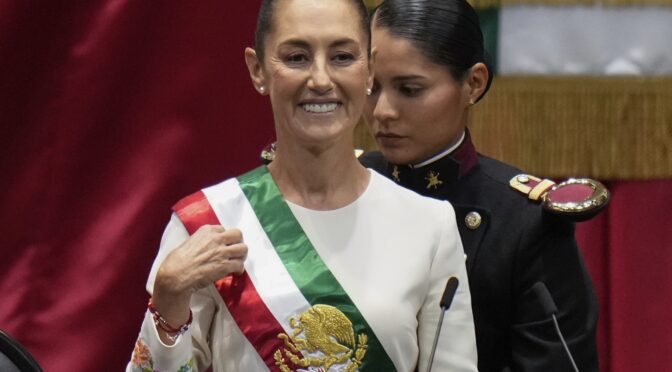
Mexican President Claudia Sheinbaum’s response

The Mexican President Claudia Sheinbaum’s response to the US tariffs was delivered in robust language.

Writing on X, she described the White House’s statement as “slander” against the Mexican government, after the Trump administration had accused it of having an “intolerable alliance” with Mexican drug trafficking organisations.

“If such an alliance exists”, President Sheinbaum wrote, “it is in the United States gun-manufacturers that sell high-powered weapons to these criminal groups” – part of a dispute Mexico has had with Washington for some years now, calling on the US to do more to clampdown on the illegal flow of guns south to arm the cartels.

Mexico didn’t want confrontation, said President Sheinbaum, and she has proposed the creation of a joint working group between their respective public health and security teams.

However, her key point came at the end of her statement: she had instructed the Economy Secretary, Marcelo Ebrard, to implement what she called “Plan B”, adding that it included “tariff and non-tariff measures in defence of Mexico’s interests”.

The measures are expected to include retaliatory tariffs of 25% on US goods, which President Sheinbaum has repeatedly said would be a central part of her government’s response.