Category Archives: business

Air Canada Forced Back to Work

Air Canada Forced Back to Work: A Blow to the Right to Strike?

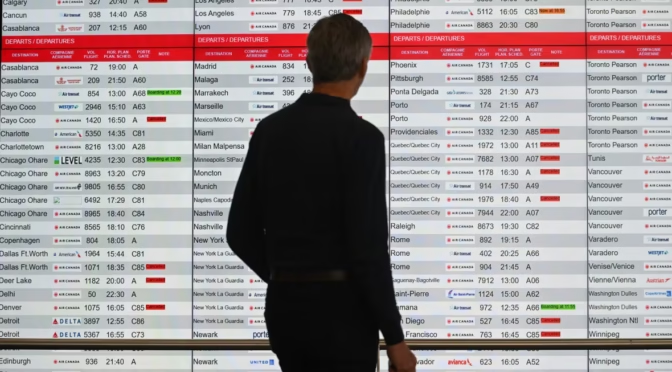
In a dramatic turn of events, the Canadian government intervened less than 12 hours into the strike by 10,000 Air Canada flight attendants on August 16, 2025, ordering them back to work and imposing binding arbitration to resolve the dispute

The sudden escalation followed a strike that grounded nearly 700 flights and affected over 100,000 travelers, in the middle of peak summer travel season

Federal Jobs Minister Patty Hajdu justified the move by citing economic risk, trade pressures, and the need for stability s. However, the Canadian Union of Public Employees (CUPE) promptly condemned the intervention, calling it an overreach that undermines workers’ bargaining power. Union leaders accused the government of “rewarding Air Canada’s refusal to negotiate fairly” and violating the constitutional right to strike 


Legal Context: Right to Strike vs. Government Intervention

Canada’s Supreme Court affirmed in Saskatchewan Federation of Labour v Saskatchewan (2015) that the right to strike is constitutionally protected, integral to collective bargaining Yet, Canadian governments—both federal and provincial—have long held authority to enact back-to-work legislation or force binding arbitration in certain federally regulated sectors, including air travel 

Historically, such measures have been used repeatedly. For instance, during the 2018 Canada Post strikes, rotating strikes were ended by back-to-work legislation  Courts have sometimes challenged these interventions—in 2016, a judge ruled that the federal back-to-work legislation in a 2011 Canada Post dispute violated the Supreme Court’s 2015 recognition of the constitutional right to strike 


Is This a Case of Rights Being Suppressed?

This latest move continues a pattern where economic urgency trumps bargaining autonomy, especially in critical services like transportation. Despite the constitutional affirmation of the right to strike, legislation still permits the government to short-circuit industrial action:

  • Pro: The intervention may be seen as necessary to prevent widespread economic disruption and protect travelers and supply chains.

  • Con: It risks weakening workers’ leverage, particularly among a female-majority workforce (flight attendants), while similar pay increases were recently awarded to a mostly male pilot group—raising concerns about equity and representation 


Sample Social Media Post

Government Forces Air Canada Flight Attendants Back to Work — But at What Cost to Workers’ Rights?

Just hours into a disruptive strike over pay and unpaid duties, the federal government stepped in to force 10,000 flight attendants back to work and dictated binding arbitration. Is this protecting the economy—or undermining the constitutional right to strike?

While economic stability is crucial, especially during peak travel, this pattern of intervention raises troubling questions about whose interests are prioritized. Does this serve Canadians—or silence workers demanding fair treatment?


Bottom Line

  • The right to strike in Canada is constitutionally protected, but back-to-work measures remain lawful, especially in essential sectors like aviation.

  • The government’s swift action in the Air Canada dispute follows historical precedent and legal authority—but not without controversy.

  • The tension between workers’ rights and national interests continues to raise critical debates about fairness, equity, and the future of labor relations in Canada.

Carbon Tax Removal: Coming April 1 in Canada

Carbon Tax Removal: Price Changes Coming April 1 in Canada

Starting April 1, Canada will see changes in prices as the federal government removes the carbon tax on certain fuels. This move is expected to bring relief to consumers, particularly in regions where fuel costs have been a major concern.

While some prices may decrease due to the tax removal, other factors like global markets and supply chains could still influence overall costs. Businesses and consumers alike will be watching closely to see how this affects transportation, goods, and household expenses.

A Moncton woman collected 45 power bills to investigate higher rates.

NB Power is modernizing New Brunswick’s electrical grid by deploying smart meters across the province. As of March 2025, over 220,000 smart meters have been installed since the mass rollout began on November 1, 2023. ​
NB Power

Smart meters resemble traditional meters but offer two-way communication over a secure network, providing real-time data on electricity consumption. This enables customers to monitor and manage their energy usage more effectively, with access to detailed consumption information in 15-minute intervals. ​
NB Power
NB Power

While many customers appreciate the enhanced insights and control over their energy consumption, some have reported concerns. For instance, a customer noted a 75% increase in their power bill following the installation of a smart meter. In response to such issues, NB Power initiated an independent assessment in February 2025 to ensure billing and metering accuracy. ​
NB Power+4NB Power+4Reddit+4
Reddit
NB Power

To address questions and provide information, NB Power has been conducting information sessions across the province. These sessions offer customers the opportunity to learn more about smart meters, their benefits, and to voice any concerns. ​
NB Power

As the rollout continues, NB Power aims to enhance the efficiency and reliability of the electrical grid, empowering customers with better tools to manage their energy consumption.​
NB Power

Confronting significant trade challenges

Saint John, New Brunswick, is confronting significant trade challenges, with the oil industry bearing the brunt of the impact. The recent imposition of 25% tariffs by the United States on Canadian goods threatens to disrupt the city’s economic stability, particularly affecting its pivotal oil sector.

Home to Canada’s largest oil refinery, Irving Oil, Saint John’s economy is deeply intertwined with the energy sector. The refinery processes over 320,000 barrels daily, with more than 80% exported to the U.S. These tariffs could lead to increased costs for U.S. consumers and jeopardize energy security across the region.

The Atlantica Centre for Energy emphasizes that the integrated energy systems of Atlantic Canada and New England are at risk. The Centre warns that consumers and businesses on both sides of the border may face higher energy prices, undermining the energy security that both regions rely on.

Local leaders express concern over the potential economic repercussions. Fraser Walls, board chair of the Saint John Chamber of Commerce, fears a multi-billion dollar impact on the local economy, noting that in 2023, New Brunswick exported $15.5 billion worth of goods to the U.S., with a significant portion originating from Saint John.

The situation underscores the need for collaborative efforts between government and industry leaders to resolve these trade disputes. Protecting Saint John’s economic future requires safeguarding its vital oil industry and maintaining the longstanding trade relationships that have benefited both Canada and the United States.