✈️ Wallace Rupert Turnbull — The Saint John Inventor Who Changed Aviation
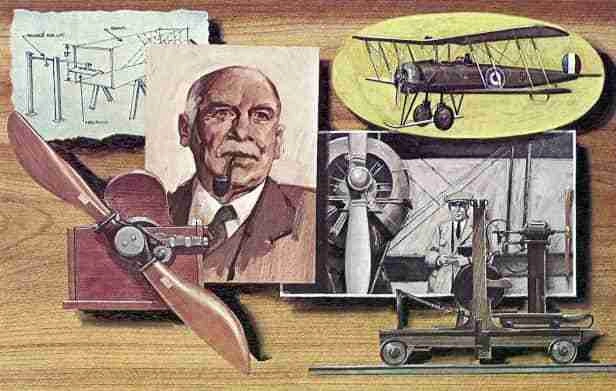
A Saint John-born inventor helped revolutionize aviation with an invention that became an essential part of propeller-driven aircraft.
His name was Wallace Rupert Turnbull, and his story is one of the remarkable but sometimes overlooked chapters in the history of Saint John and New Brunswick.
Turnbull was born in Saint John, New Brunswick, on October 16, 1870. He became an engineer, scientist and inventor whose work eventually earned him recognition as one of Canada’s pioneering aeronautical engineers.
🏠 From Saint John to Rothesay
Turnbull studied mechanical engineering at Cornell University, graduating in 1893. He then continued his education in physics at the universities of Berlin and Heidelberg in Germany.
After working briefly in the United States, he returned to New Brunswick and established himself as a consulting engineer in Rothesay.
It was there that he built a private research laboratory and began conducting experiments that would eventually put his name into aviation history.
🌬️ Canada’s First Wind Tunnel
Long before aviation became a mature science, Turnbull was experimenting with the forces acting on aircraft.
In 1902, he built what Parks Canada identifies as the first wind tunnel in Canada.
His research examined aircraft stability, airfoils and the behaviour of air flowing around wings and propellers.
Turnbull was developing a scientific approach to aviation at a time when powered flight was still in its infancy. Canada’s historical aviation record later described him as a pioneer of aeronautical research.
🔧 The Variable-Pitch Propeller
Turnbull’s most important invention was his controllable variable-pitch propeller.
A conventional propeller has blades set at a particular angle. Turnbull developed a system that allowed the pitch, or angle, of the propeller blades to be changed, making it possible to adjust the propeller for different flying conditions.
In simple terms, it allowed an aircraft to use its propeller more efficiently.
The technology could improve performance during different stages of flight, including takeoff and cruising.
The Government of New Brunswick lists February 7, 1922, as the date Turnbull patented his variable-pitch propeller in Rothesay.
✈️ From Rothesay to the Skies
Turnbull’s development did not happen overnight.
He had worked on propeller designs during the First World War and continued developing his controllable-pitch system after returning to Canada.
A working version of his electrically controlled mechanism was eventually constructed and successfully tested at Camp Borden, Ontario, in 1927.
That successful test demonstrated that Turnbull’s idea could work in actual flight.
His invention represented an important advance in aviation because pilots could adjust propeller pitch to match changing flight conditions.
🌎 An Internationally Important Invention
Turnbull’s invention attracted international attention.
Patent rights were eventually licensed to major aircraft interests, and his design became associated with the Curtiss-Wright propeller system.
Historical records note that the Turnbull design was subsequently manufactured in large numbers.
The significance of his invention extended well beyond the aircraft on which it was first tested.
The same basic principle of changing blade pitch became important in later propeller technology.
🌊 Turnbull Was Interested in More Than Aviation
Aviation wasn’t Turnbull’s only scientific interest.
He also studied tidal power, including the possibility of harnessing the enormous tides of the Bay of Fundy.
In 1919, he presented a proposal concerning tidal power involving the Petitcodiac and Memramcook Rivers.
He later became associated with the Petitcodiac Tidal Power Company.
His interests also included hydroplanes, torpedo screens and bomb sights.
This wide range of interests demonstrates the remarkable scientific curiosity of a man who lived at a time when many of these technologies were still being developed.
🏅 Recognition
Turnbull eventually received significant recognition for his work.
The University of New Brunswick awarded him an honorary Doctor of Science degree in 1942.
He was also recognized by engineering and aeronautical organizations in Canada and Britain.
In 1977, more than two decades after his death, he was inducted into Canada’s Aviation Hall of Fame.
🏛️ A National Historic Person
Canada also recognized Turnbull’s contribution by designating him a National Historic Person in 1960.
A commemorative plaque stands in Saint John, New Brunswick.
Parks Canada highlights both his construction of Canada’s first wind tunnel and his development of the controllable variable-pitch airscrew.
✈️ Turnbull Field
His name has also been associated with aviation in Saint John.
The Saint John Airport was named Turnbull Field in his honour for a period, reflecting the importance of his contribution to Canadian aviation.
The original propeller associated with his pioneering work is preserved at the Canada Aviation and Space Museum in Ottawa.
🌟 A Saint John Inventor Who Changed Aviation
Wallace Rupert Turnbull may not be as famous as some other Canadian inventors, but his contribution was extraordinary.
He was born in Saint John in 1870, returned to New Brunswick after studying abroad, and established his research laboratory in Rothesay.
There, he pursued aviation research when powered flight was still a new and uncertain technology.
His variable-pitch propeller became one of his most important achievements and helped establish a technology that remains fundamental to propeller-driven aircraft.
A New Brunswick Legacy
Born: October 16, 1870 — Saint John, New Brunswick
Died: November 1954 — Saint John, New Brunswick
Profession: Engineer, scientist and inventor
Major achievement: Controllable variable-pitch aircraft propeller
First Canadian wind tunnel: Built in Rothesay, 1902
Propeller patent: 1922
Successful flight testing: Camp Borden, 1927
National Historic Person: Designated 1960
Canada’s Aviation Hall of Fame: Inducted 1977
From a laboratory in Rothesay to aircraft flying around the world, Wallace Rupert Turnbull left a remarkable legacy.
He is another example of a New Brunswick inventor whose work had an impact far beyond the province — and whose story deserves to be remembered in Saint John.
Sources
Parks Canada — Wallace Rupert Turnbull
Canada’s Aviation Hall of Fame — Wallace Rupert Turnbull
Government of New Brunswick — This Week in New Brunswick History
Canada Post — Canadians in Flight
Discover Saint John — A City of Firsts




 Canada briefing for this week —