Category Archives: Weather

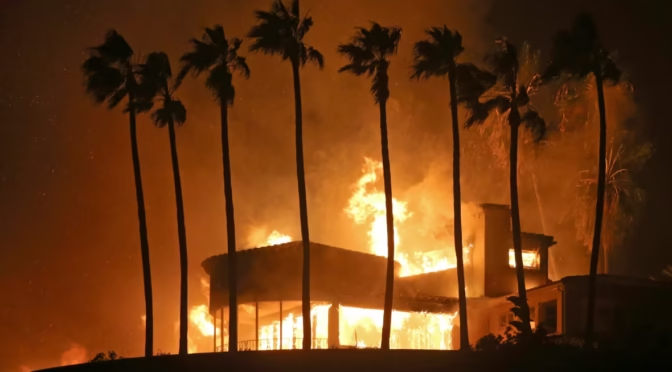
Why are trees still standing next to burned-out buildings in Los Angeles?

Palm trees in California are surprisingly resilient to fire, but they are not completely immune. Several factors explain why they don’t always burn in wildfires, despite their proximity to fire-prone environments:


1. Height and Structure

  • Palm trees have tall trunks with most of their foliage (fronds) at the top, away from ground-level flames. In many cases, wildfires burn along the ground and do not reach the tree canopy.
  • The smooth and fibrous bark of some palm species can also limit the fire’s ability to climb up the trunk easily.

2. Moisture Content

  • Healthy palm trees contain a high level of moisture in their trunks and leaves, which makes them less flammable compared to drier trees or shrubs.
  • Their large, thick trunks act as a reservoir, retaining water and making them more fire-resistant.

3. Fire-Resistant Species

  • Many ornamental palm species planted in California are not native and are chosen for their drought tolerance and fire resistance. For example, Canary Island Date Palms and Mexican Fan Palms are commonly seen in urban areas and are more fire-resistant than some native vegetation.

4. Fire Behavior

  • Palm trees are often found in urban or landscaped areas where brush and grasses (primary fuel for wildfires) are regularly cleared. As a result, the fire may not have enough fuel to sustain itself around the palms.
  • However, if palm trees have dry, dead fronds hanging down, these can act as “fire ladders,” allowing flames to reach the canopy and ignite the tree.

5. Maintenance

  • In urban settings, palm trees are frequently pruned to remove dead fronds, which would otherwise act as kindling. Regular maintenance reduces the risk of them catching fire.

When Do Palm Trees Burn?

While they are more resistant than other trees, palm trees can still burn under certain conditions:

  • Dead Fronds: Unmaintained palms with dead or dry fronds are highly flammable and can ignite during a wildfire or from embers.
  • Prolonged Exposure: Prolonged contact with high-intensity flames can overwhelm even the most resilient trees.
  • Drought Stress: A stressed or dying palm with low moisture content is more likely to burn.

In short, palm trees are more fire-resistant than other vegetation due to their height, moisture content, and sometimes human maintenance, but they are not entirely fireproof.
Climate Change on Maritime Canada

The Impact of Climate Change on Maritime Canada: A Call for Action

Maritime Canada—comprised of Nova Scotia, New Brunswick, and Prince Edward Island—is a region steeped in natural beauty, cultural history, and strong connections to the Atlantic Ocean. Yet, this coastal region is on the front lines of climate change, facing a growing number of environmental and economic challenges. From rising sea levels to shifting weather patterns, the effects of climate change are already reshaping Maritime Canada in profound ways.

Rising Sea Levels and Coastal Erosion

One of the most immediate and visible impacts of climate change in the Maritimes is the rise in sea levels. The Atlantic coast is particularly vulnerable, with erosion threatening homes, infrastructure, and iconic landscapes like the Bay of Fundy. Saltwater intrusion is also affecting farmland, making agriculture—a cornerstone of the region’s economy—more difficult in certain areas.

Communities such as Charlottetown, PEI, and Halifax, NS, are already experiencing flooding during storm surges. Without significant investment in coastal defenses and sustainable urban planning, these challenges will only worsen, putting livelihoods and ecosystems at risk.

Changing Fisheries

Fisheries are the backbone of Maritime Canada’s economy, but they’re under threat as ocean temperatures rise and ecosystems shift. Lobsters, for example, are migrating further north in search of cooler waters, disrupting traditional fishing grounds. Invasive species like green crabs are becoming more prevalent, further stressing marine biodiversity.

With warming waters and ocean acidification, shellfish and other marine life critical to the Maritimes’ economy are facing uncertain futures. This not only impacts local fishers but also the broader communities that rely on seafood processing and exports.

Extreme Weather Events

Hurricanes, heavy rainfall, and ice storms are becoming more frequent and intense in the region, largely due to climate change. Events like Hurricane Fiona in 2022 showcased the devastating potential of these storms, causing widespread power outages, structural damage, and even loss of life.

Beyond the immediate destruction, these events come with long-term economic consequences, from the cost of rebuilding to the strain on insurance systems. For rural and island communities, recovery can be especially slow, highlighting the need for stronger disaster preparedness and resilient infrastructure.

Impacts on Tourism and Natural Beauty

The Maritimes are world-renowned for their picturesque coastlines, national parks, and quaint seaside towns. However, changing weather patterns, rising sea levels, and threats to biodiversity are putting this natural charm at risk. Warmer winters mean less snow for activities like skiing, while unpredictable weather during the summer months can deter visitors.

Tourism operators are increasingly recognizing the need for sustainable practices and climate adaptation strategies to protect the very landscapes that attract millions of visitors each year.

The Path Forward: Resilience and Adaptation

While the challenges are significant, the Maritimes also have an opportunity to lead in climate adaptation and sustainability. Local governments and organizations are already stepping up:

  • Coastal Protection: Communities are investing in nature-based solutions like restoring salt marshes and dunes to act as buffers against storm surges.
  • Renewable Energy: Offshore wind and tidal power projects are being explored to reduce reliance on fossil fuels and support clean energy goals.
  • Sustainable Fisheries: Innovations in aquaculture and fishing practices aim to protect marine ecosystems while maintaining economic viability.
  • Community Resilience: Local groups are working on disaster preparedness plans, promoting climate education, and fostering collaboration between municipalities.

What Can You Do?

Residents of Maritime Canada have a vital role to play in addressing climate change. Simple actions like reducing energy consumption, supporting local and sustainable businesses, and advocating for strong climate policies can collectively make a big difference.

Let’s protect Maritime Canada’s rich heritage and natural beauty for future generations. The time for action is now.

What are your thoughts on how the Maritimes can adapt to climate change? Share your ideas and experiences below!

SNOWFALL WARNING

SNOWFALL WARNING

Snowfall with total amounts of 15 to 25 cm, except up to 40 cm over areas of higher terrain. Locations: Saint John and County, Sussex – Kennebecasis Valley and Kings County, and Fundy National Park Time span: Ending tonight. Remarks: Snowfall warnings are issued when greater than 15 cm of snow is expected to occur in 12 hours or less. In some localities snowfall rates briefly as high as 5 cm an hour will cause very poor visibilities and travel conditions. Rapidly accumulating snow could make travel difficult over some locations. Visibility may be suddenly reduced at times in heavy snow. Public Safety Canada encourages everyone to make an emergency plan and get an emergency kit with drinking water, food, medicine, a first-aid kit and a flashlight. Snowfall warnings are issued when significant snowfall is expected.

Saint John, a fresh blanket of snow

As Saint John, New Brunswick, awakens under a fresh blanket of snow, the city transforms into a picturesque winter wonderland. The recent storm, delivering approximately 14 centimeters of snow accompanied by gusty winds, has painted our streets and parks in pristine white.

Country 94

While the snowfall brings a serene beauty, it also presents challenges. Roads are snow-covered, and visibility is reduced in some areas due to drifting snow. Residents are advised to exercise caution during travel and consider postponing non-essential journeys until conditions improve.

Country 94

Despite these challenges, the community’s resilience shines through. Neighbors are seen helping each other clear driveways, and the sound of snowblowers fills the air. The local authorities are working diligently to restore normalcy, ensuring that the festive spirit remains undampened.

As we navigate the aftermath of this pre-Christmas storm, let’s embrace the beauty it brings and the sense of togetherness it fosters. Stay safe, stay warm, and enjoy the winter magic that has enveloped our city.