4 new constables

The Saint John Police Force has recently welcomed four new constables: Benjamin Cannon, Arjun Chauhan, Owen Lohnes, and Carlo Mariano. These officers were sworn in during a ceremony at police headquarters on January 10, 2025, and have begun their duties immediately.

Saint John police welcome 4 new constables

From left: Benjamin Cannon, Arjun Chauhan, Owen Lohnes and Carlo Mariano

All four recruits were selected by the force’s recruitment team and sponsored to attend the Atlantic Police Academy, where they completed six months of training. Chief Robert Bruce expressed pride in the new members, stating, “We are very proud of our newest members. Each of them brings a uniqueness that will have a positive impact on our service delivery as we continue to focus on community engagement keeping our city safe, secure and healthy.”

Constable Owen Lohnes has a personal connection to the force, as his father, Jason, is a long-serving member who influenced his decision to pursue a career in policing. Additionally, Constable Arjun Chauhan, who moved to New Brunswick from India in 2019, participated in the force’s first inclusion and diversity recruitment camp last year. He is the first participant from that camp to be hired by the force, highlighting the department’s commitment to diversity and community representation.

With these new additions, the Saint John Police Force now comprises 146 officers dedicated to serving the community.
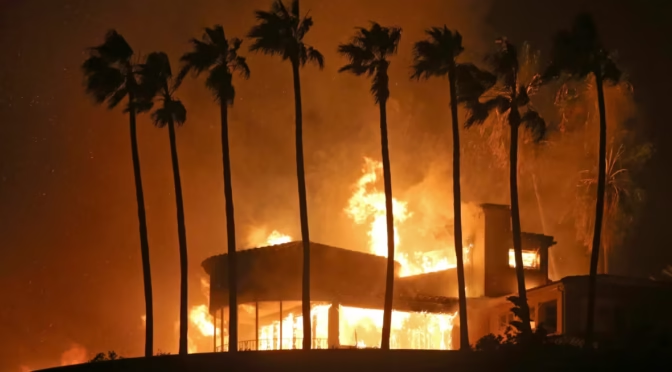
Why are trees still standing next to burned-out buildings in Los Angeles?

Palm trees in California are surprisingly resilient to fire, but they are not completely immune. Several factors explain why they don’t always burn in wildfires, despite their proximity to fire-prone environments:


1. Height and Structure

  • Palm trees have tall trunks with most of their foliage (fronds) at the top, away from ground-level flames. In many cases, wildfires burn along the ground and do not reach the tree canopy.
  • The smooth and fibrous bark of some palm species can also limit the fire’s ability to climb up the trunk easily.

2. Moisture Content

  • Healthy palm trees contain a high level of moisture in their trunks and leaves, which makes them less flammable compared to drier trees or shrubs.
  • Their large, thick trunks act as a reservoir, retaining water and making them more fire-resistant.

3. Fire-Resistant Species

  • Many ornamental palm species planted in California are not native and are chosen for their drought tolerance and fire resistance. For example, Canary Island Date Palms and Mexican Fan Palms are commonly seen in urban areas and are more fire-resistant than some native vegetation.

4. Fire Behavior

  • Palm trees are often found in urban or landscaped areas where brush and grasses (primary fuel for wildfires) are regularly cleared. As a result, the fire may not have enough fuel to sustain itself around the palms.
  • However, if palm trees have dry, dead fronds hanging down, these can act as “fire ladders,” allowing flames to reach the canopy and ignite the tree.

5. Maintenance

  • In urban settings, palm trees are frequently pruned to remove dead fronds, which would otherwise act as kindling. Regular maintenance reduces the risk of them catching fire.

When Do Palm Trees Burn?

While they are more resistant than other trees, palm trees can still burn under certain conditions:

  • Dead Fronds: Unmaintained palms with dead or dry fronds are highly flammable and can ignite during a wildfire or from embers.
  • Prolonged Exposure: Prolonged contact with high-intensity flames can overwhelm even the most resilient trees.
  • Drought Stress: A stressed or dying palm with low moisture content is more likely to burn.

In short, palm trees are more fire-resistant than other vegetation due to their height, moisture content, and sometimes human maintenance, but they are not entirely fireproof.