This Week in New Brunswick History

Here’s “This Week in New Brunswick History” for the current week (around March 22–28):


📜 March 22

  • 1827Alexander “Boss” Gibson was born. He became a major lumber and railway industrialist and helped develop Marysville into a model mill town.

📜 March 23

  • 1867 – The British North America Act received Royal Assent, paving the way for New Brunswick to join Confederation later that year.

📜 March 24

  • 1905Louis Robichaud, future premier and architect of major social reforms (Equal Opportunity program), was born in Sainte-Anne-de-Kent.

📜 March 25

  • 1842 – The Webster–Ashburton Treaty boundaries (affecting New Brunswick and Maine) continued to shape settlement and governance after earlier disputes like the Aroostook conflict.

📜 March 26

  • 1875 – The Common Schools Act tensions were still influencing politics and religion in the province during this period, especially among Catholic communities.

📜 March 27

  • 1912 – New Brunswickers followed closely as the Sinking of the RMS Titanic inquiries and news spread (many Atlantic Canadians had connections to passengers and crew).

📜 March 28

  • 1968 – Expansion of francophone education and institutions accelerated during the era of Premier Louis Robichaud, shaping modern bilingual New Brunswick.
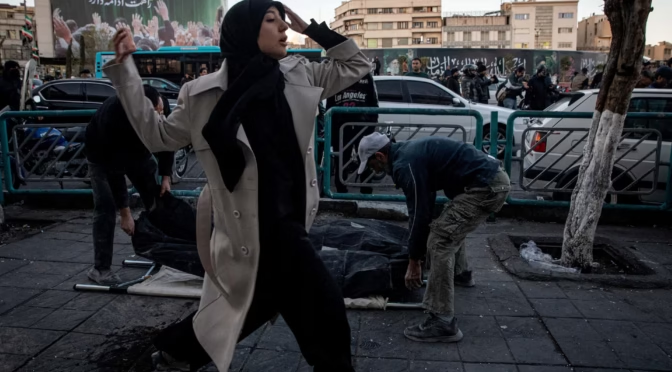

Middle East Conflict Quiz

🌍 Middle East Conflict Quiz

Multiple Choice

1. The recent major escalation in conflict began after which event in October 2023?
A. A peace agreement
B. A large-scale attack by Hamas on Israel
C. A UN summit
D. A natural disaster


2. Which group controls the Gaza Strip?
A. Hezbollah
B. Hamas
C. ISIS
D. Taliban


3. Which country is in conflict with Hamas?
A. Egypt
B. Israel
C. Jordan
D. Turkey


4. Hezbollah is primarily based in which country?
A. Syria
B. Iraq
C. Lebanon
D. Iran


5. Which global organization often calls for ceasefires and humanitarian aid?
A. NATO
B. United Nations
C. FIFA
D. OPEC


True or False

6. The conflict only affects military targets and not civilians.
True / False


7. Humanitarian aid includes food, water, and medical supplies.
True / False


8. Multiple countries and groups are involved directly or indirectly in the conflict.
True / False


Short Answer

9. What is a “ceasefire”?
(Write a brief definition)


10. Name one country in the Middle East that is not directly involved in the conflict but is affected by it.


Bonus Question

11. Why is the Middle East considered important globally?
(Think about geography, resources, and history)


✅ Answer Key

  1. B

  2. B

  3. B

  4. C

  5. B

  6. False

  7. True

  8. True

  9. A temporary stop in fighting

  10. Answers may vary (e.g., Jordan, Saudi Arabia, Egypt)

  11. Answers may include oil resources, location between continents, and historical/religious significance

Trumps Mess

What we are watching unfold right now is deeply concerning.

A conflict with Iran was initiated under Donald Trump, and now—after escalation—there’s growing pressure on the rest of the world to step in and help manage the fallout.

But here’s the reality: many countries are refusing.

Allies across Europe and beyond have declined to join military operations or send support, with leaders clearly worried about being pulled into a wider war with no clear end.

Some nations weren’t even consulted before the conflict began, and now they’re being asked to participate after the fact.

At the same time, voices inside the U.S. itself are raising concerns. Senior officials have even resigned, questioning whether this war was justified or necessary.

This isn’t about refusing to help—it’s about refusing to be dragged into a situation that many believe was avoidable.

The world is not lining up to fight a war driven by one leader’s decisions—especially after years of strained relationships and public insults toward those same allies.

And perhaps the most important question of all:
Where was the voice of the American people before this began?

War affects everyone. It shouldn’t be something the world is expected to clean up after the fact.

Highest number of people of Irish descent per capita.

Saint John, New Brunswick, is often noted for having a significant Irish community. The city has deep historical ties to Ireland, especially due to the large number of Irish immigrants who arrived in the 19th century during the Great Famine. It’s estimated that a large percentage of the city’s population has Irish roots, making it  the place in Canada with the highest number of people of Irish descent per capita.

St Patricks Day Beer Images – Browse 110,664 Stock Photos ...

This Irish influence is still visible today in local culture, with events like the annual Saint Patrick’s Day celebrations being a big deal in the city.

St. Patrick's Day

Ides of March

The Ides of March refers to March 15 in the ancient Roman calendar. It’s most famous for the assassination of Julius Caesar in 44 BC.

What happened

On March 15, 44 BC, Caesar was stabbed to death by a group of Roman senators inside the Theatre of Pompey. The conspirators feared that Caesar was becoming too powerful and might end the Roman Republic by turning it into a monarchy.

Key conspirators included:

  • Marcus Junius Brutus

  • Gaius Cassius Longinus

  • Dozens of other senators.

Why it’s famous

  • It marked a major turning point that eventually led to the fall of the Roman Republic and the rise of the Roman Empire.

  • It inspired famous lines in William Shakespeare’s play Julius Caesar, including the warning:
    “Beware the Ides of March.”

What “Ides” actually means

In the Roman calendar:

  • Ides was the middle of the month.

  • It fell on the 15th in March, May, July, and October, and the 13th in other months.

✅ Today, “Ides of March” is often used as a phrase meaning a warning about betrayal or impending danger.

error: Content is protected !!